
Mike and I disagreed on one of his stories this week. Of course, we’ll start with the story:
No Touchie
“Following an increase in overly physical behavior last term that disrupted learning and raised safety concerns,” said Stephanie Neill, headteacher at Philip Morant School and College in Colchester, England, “we set a clear expectation of no physical contact to maintain a calm and welcoming environment.” Hundreds of parents protested, asking the school to “reconsider its blanket no-contact rule” as it “teaches children that all physical contact is wrong … including normal interactions such as hugging, high fives, or comforting somebody who is upset.” Students were being sent to detention for violating the rules. The school worked with the student council, and adjusted the policy. “As a result, normal methods of greeting and comforting friends will be acceptable when done in the right way and in the right context,” Neill announced. (MS/Colchester Gazette) …Good. Better: Listening to the students the first time.
First Impression
Mike’s take on the tagline is that parents won for their kids after protesting the school’s zero-tolerance policy. I can understand that point of view, but in my opinion, this wasn’t actually a win.

The concession is that even “comforting friends” is now permitted only when “done in the right way and in the right context.” These are children (aged 11-18 at this particular school), and it’s natural to comfort friends who are hurting. Yet now they have to think about “context” and hugging a friend “in the right way” to appease priggish authority figures? That’s pathetic, not a win. The hard part is expressing that concisely.
I whipped up three tags that concisely expressed my take on the story, suggesting he might come up with a twist that worked for him:
- …Compassion: OK subject to administrative approval.
- …Hugs permitted. Terms and conditions apply.
- …Human kindness: now allowed in approved contexts.
I sent them to Mike, but they were not his point of view, and it is OK that he rejected them on a story “signed” with his initials.
Yes, the school budged …just barely. I simply argue that human kindness cannot only be allowed in undefined approved contexts. The kids don’t need instruction on how to be decent people, the administrator does. Quite simply, zero tolerance is not just obliviocy; sometimes, it’s evil.
Those parents shouldn’t be satisfied with their “win”: they need to press for more.
Mike Responds
Mike is working on moving to a new city, so he didn’t have a lot of time to flesh out his thoughts. But he did send this:
“The full quote from the principal shows that this wasn’t the administration trying to set arbitrary boundaries for the contact, but an effort to allow for reasonable touching while providing some safety for the students who had been experiencing bullying behavior (the reason for the initial policy):
We have worked closely with our student council over the last couple of weeks discussing with them what constitutes appropriate and inappropriate physical contact.
Our students have shown great maturity throughout the discussions and provided some insightful views.
As a result, normal methods of greeting and comforting friends will be acceptable when done in the right way and in the right context.
We will share these views with all students next week and students, staff and parents will be able to feedback on the ideas.
“They worked with the students this time to reach a reasonable solution.”
Expanding My Point
My read of the source stories, “Philip Morant’s new ‘no touching’ rule slammed by parents” (Colchester Gazette, 17 Sep 26), followed by “Colchester school softens no-touch rule after parent protest) (30 Sep 26), don’t support that bullying was a primary reason for the new rule.
That actually was mentioned almost in passing not by school officials, but by parent Jen Summers in her petition to have the rule “reconsidered”:
We fully support the school taking firm action against fighting, bullying, unwanted touching and unsafe or inappropriate behaviour.
Our concern is the current rule prohibits all physical contact between pupils, including normal interactions such as hugging, high fives or comforting somebody who is upset.
Pupils are receiving detentions and isolation for breaching this rule.
We want to work with the school to find a more balanced approach that keeps our children safe and supports their wellbeing.
She is not asking for a free-for-all, but rather that “We want our children to learn what appropriate behaviour looks like, not simply be taught that all physical contact is inappropriate.” You know: to be normal, caring humans.
I obviously don’t support bullying or unwanted contact, but isn’t violent attack and sexual harassment already prohibited and reasonably well defined in the school’s code? If not, they ought to be — yet after “reconsideration” we are still left with “normal methods of greeting and comforting friends” being acceptable only “when done in the right way and in the right context.”
What defines the “right way” and “right context”?
I look forward to reader comments on this.
All this said, my link to the school’s web site is not a suggestion that anyone mailbomb school officials: that does not help, as the linked page (from 2001!) makes clear. The intent of this page isn’t to fight Morant, but rather to show how to take a step back from bureaucratic language to get a bigger picture of what’s being said. It’s to give you awareness so you can monitor what’s being said by bureaucrats who govern you and your children.
About the School
“Our vision is simple,” the school says on its home page: “a community where everyone feels they belong and are the best they can be. We are the largest school in Colchester serving a community of 11-18 year old [sic] students. Our school was described as having a ‘warm family feel’ in our Ofsted inspection in September 2023.”
It’s awfully hard to reconcile that boast with demands that children must “comfort friends” only “in the right way and in the right context.” Their “simple vision” is clouded.
As for the Headteacher herself, she has this to say on her “welcome” page: “Our values are: ‘Aspiration, Success, Kindness’ which underpin our approach to all aspects of school life. We regularly celebrate these values being demonstrated by our students and our staff.”
Celebrating them by creating anti-human zero tolerance rules? Her actions speak much louder than her words.
Who was Morant?
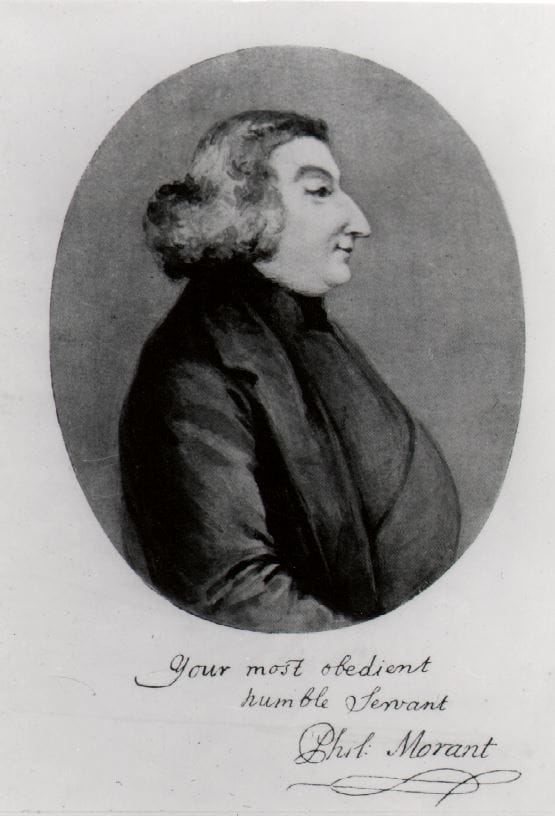
Philip Morant (1700-1770) was an English clergyman and author, celebrated in Essex for documenting the county in his book, The History and Antiquities of the County of Essex, originally published in two volumes (1763 and 1768). A modern printing is available in a single 500-page paperback on Amazon *.
An amateur archeologist, Morant also conducted several of excavations of Roman sites in and around Colchester, where he lived, and he was elected to the Fellowship of the Society of Antiquaries of London. He later served in Parliament.
The school was named for him when it was founded in 1965. The school has a copy of the original publication of Morant’s History on permanent loan from the Essex Archaeological Society.
– – –
Bad link? Broken image? Other problem on this page? Please Let Me Know using the Help button in the lower right, and thanks.
This page is an example of my style of “Thought-Provoking Entertainment”. This is True is an email newsletter that uses “weird news” as a vehicle to explore the human condition in an entertaining way. If that sounds good, click here to open a subscribe form.
To really support This is True, you’re invited to sign up for a subscription to the much-expanded Premium edition.
I see where Mike is coming from, but I’m definitely with Randy on this one. As a kid who was bullied — and who constantly fell afoul of rules I thought I was on the right side of but which had subtleties and exceptions I was unaware of but both my peers AND the adults in my life thought should have been obvious — I would be MORE afraid of a policy saying comforting touches “within certain parameters” were allowed.
One of the problems with this policy is that it will be unequally applied. Not could — WILL. It’s not going to stop bullying, it just means that the bullies will run crying to the adults and say their victim touched them (or someone else) in a way that doesn’t fall under the guidelines. It’s also going to put queer kids, BIPOC kids, and anyone else the Establishment doesn’t like under very close scrutiny. Something harmless for a kid people “like” will be against policy for someone they don’t.
It’s possible, even probable, that the way it’s phrased in the actual ruling is clearer, but in this case it looks too vague to be of much help.
Concur, and I want to emphasize a point: kids make mistakes. They do inappropriate things, because they haven’t yet learned “the rules”. The correct response to an inappropriate action is counseling, not punishment.
At the same time, resilience is important. As the target of an inappropriate action usually the right response (the first time) is “hey, please don’t do that”, rather than running to authorities. Sometimes it also involves learning how to send messages that the behavior is not welcome *before* it becomes a problem.
I can see what the administrators are trying to say, but I agree with Randy that their wording is vague. But I’m not sure how to make it any better.
I think it’s pretty obvious that one criterion for whether a particular kind of contact is acceptable is that both parties consent to it. But beyond that, there are probably things which people consent to that still are not appropriate for this setting. We probably don’t want to allow things that are offensive in some sense.
To take an extreme example, what if two people start having consensual sex in the middle of the schoolyard? We don’t want to allow that. How about two sweethearts holding hands? That sounds innocent enough. But what if someone is offended by seeing a same-sex couple or an interracial couple? What some people find offensive, others find acceptable. Should we use something like the “community standards” test for obscenity?
I don’t have answers to all these questions, but I think this needs to be discussed before setting policy.
“Students were expressing insults at other students. School responds by not allowing any talking at school.”
This is the same type of reaction. Hopefully it shows how ridiculous the initial school rule is.