
A story in Issue #1633 brought several comments from readers. Let’s start with the story:
The 21st Century Has Arrived
A harbinger of “the future” that people have been waiting for since the turn of the 20th Century is flying cars. We perhaps didn’t expect them to come from China. Xpeng AeroHT brought two prototypes to show off at the Changchun Air Show in Jilin Province. During a rehearsal a week before the show was to begin, the company flew the cars, which they hope to sell for US$300,000 each. They hit each other in the air. One crashed and burst into flames, injuring its pilot; the fate of other car was not clear, but its pilot was declared OK. (RC/BBC, CNN) …The future is finally here, but it’s not safe for humans.


The Claim
“The flying car story reminded me of one where there were only two cars in a state and they managed to collide with each other 😉 ” —Mark in Maryland
Others were more specific: “Similar to the story (possibly urban legend) about the only 2 cars in Kansas running into each other.” —Thomas in Washington
There were more, including more than one that said it was in Ohio, but you get the idea.
I’ve heard the claim before, but I assumed that it’s so unlikely, it has to be a (false) urban legend, as Thomas suspected.
To make one point more explicit: urban legends can be — or become — true, but I assume false until proven true.
Where It Comes From
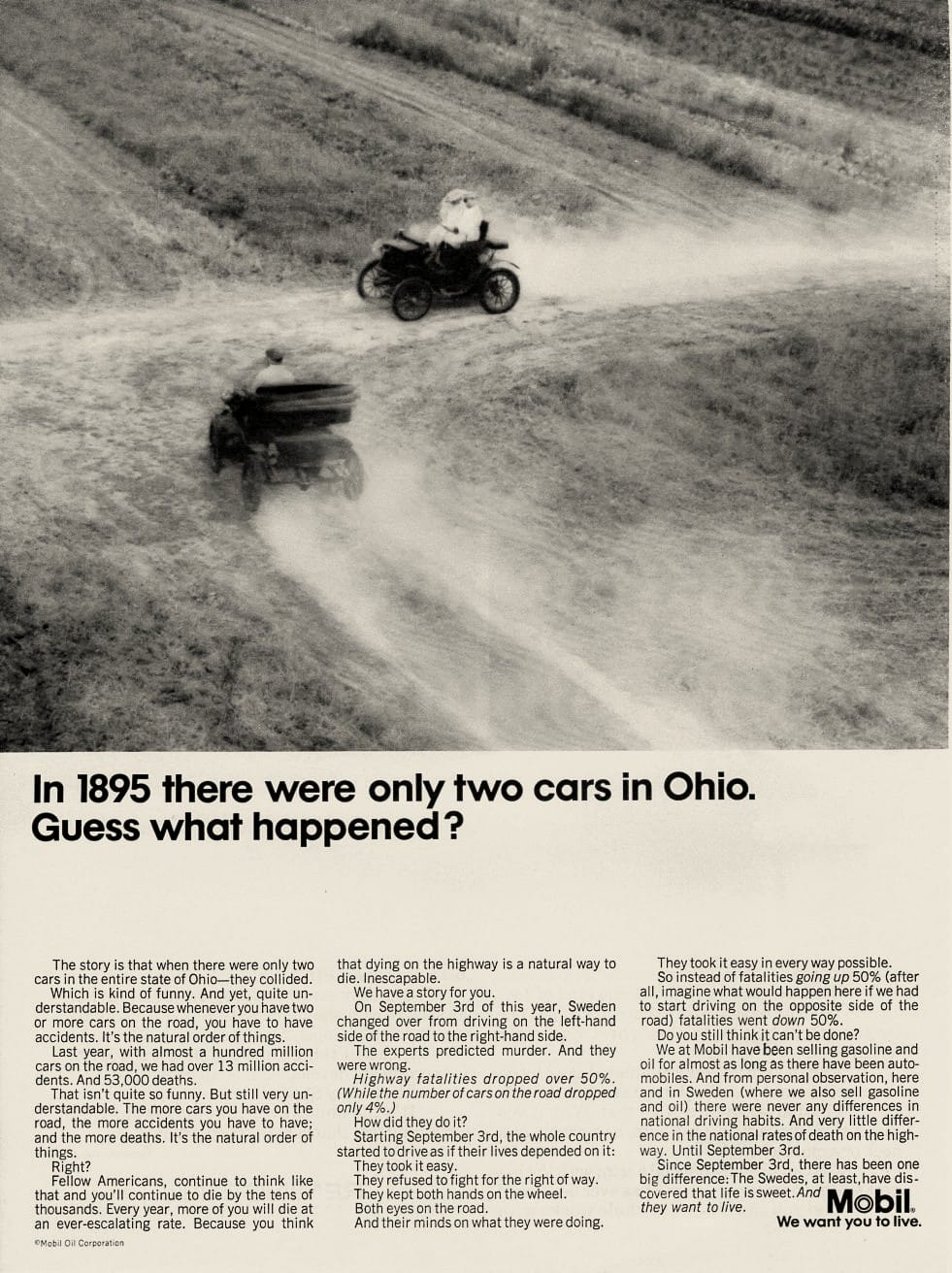
Interestingly, this particular urban legend can be specifically traced to a 1967 “public service” advertisement by Mobil Oil. And here is their ad that started this myth, published in popular magazines that November by the oil company.
It is, for sure, a thought-provoking item that probably wouldn’t run today (too wordy).
But how do we know it’s not an honest account of a real event? After all, there’s a photo! Yes, a photo …of two cars driving on a road …somewhere. It’s rather obvious that the drivers can see each other; there are no trees, or horse-drawn carriages, blocking the view. And, quite notably, they are not shown smashed into each other, despite the fact there was a photographer right there at the time.
Someone who knows cars much better than I do says these models are from c1930, which means they could not possibly have crashed into each other in 1895, the year specified in the headline. And certainly there were a lot of cars on the road, even in Ohio, by then.
More importantly, Snopes notes there were not any news stories found from the 1890s describing such an accident, as there certainly would have been had it actually happened, even if there was no photographer watching it all: it’s just too delicious a story.
The ad is simply an amusing way for Mobil to send a serious message: it hits home really well. So well that almost 58 years later, people remember it as fact.
Part of a Series
Mobil did a series of ads with the “We want you to live.” tagline. Another I have, also from 1967, is headlined, “Getting killed is easy. Staying alive is work.”
In this case, the “work” is keeping your car in good condition: testing your steering and brakes, checking the exhaust system for leaks (specifically pointing out carbon monoxide), confirming all lights are in working order, inspecting tires and wipers, buying seatbelts if your older car doesn’t have them, etc. “Nobody says it’s easy,” the ad concludes. “It takes a little work. But it won’t kill you.”
Like the “crash” ad, the headline is attention-grabbing, and it put Mobil into the public eye as a Big Corporation That Cares, which is a great idea for a company trying to sell a commodity product to a mass audience. It probably brought them many loyal customers.
You almost certainly remember other oil companies with their own ad series, also trying to sell a commodity product to the same mass audience. Remember “You can trust your car to the man who wears a star!”? I don’t have to tell you which company used that tagline since it’s much more famous than “We want you to live.”
The takeaway is really easy: don’t mistake ad campaigns for gospel truth.
– – –
Bad link? Broken image? Other problem on this page? Let Me Know, and thanks.
This page is an example of Randy Cassingham’s style of “Thought-Provoking Entertainment”. His This is True is an email newsletter that uses “weird news” as a vehicle to explore the human condition in an entertaining way. If that sounds good, click here to open a subscribe form.
To really support This is True, you’re invited to sign up for a subscription to the much-expanded Premium edition.
I do, however, find it interesting that the first pedestrian fatality in the Americas was a man run over by an ELECTRIC taxi on Central Park West in the late 1800s. Stepped off a streetcar and pow!.
What may be weirder is there’s a sign for it on the street. I was walking by and saw it.
—
Electric cars were big at the turn of the 20th century. And sure enough:
That said, Bliss was not “the first recorded motor vehicle fatality in the Western Hemisphere.” That was Mary Ward, born 1827 and an Anglo-Irish scientist. She was the first person known to have been killed by a car in Ireland, on August 31, 1869, almost exactly 30 years before Bliss. That would make her the first person killed by a car in the United Kingdom and, thus, in the Western Hemisphere. In her case, it was a steam carriage invented by her father. She was riding on it with him when it jolted and threw her to the ground, and she was subsequently rolled over. She was married (with eight children!), and 42 years old. (Source) -rc
Interesting is that the photo of the 1890 car crash is an aerial shot…17 years before the Wright.
—
Don’t worry: they had hills you could climb in the 1800s. They were invented well before that. That said, it did occur to me that the shot could have been composed. Way before computer image manipulation (“Photoshop”), but there were mechanical things that could have been done to lay in the cars on top of a photo of a road. -rc
I’m not quite old enough to remember that I can trust my car to the man who wears the star, but I do remember every time the “Check Engine” light comes on that I can either trust the Midas touch or get Peace Of Mind, Of Course. (And then I go to the local mechanics my mom has been taking her cars to for over thirty years, because ad slogans are well and good but they pale in comparison to a recommendation from someone you trust.)
On a completely unrelated note, I went to look up the story (because your photos were a bit small and I wanted a closer look at the vehicle), and the first thing I saw was a tagline describing Xpeng as “the largest flying car company in Asia”, which implies there are more, although that could also just be clever marketing. (As is calling them “flying cars”. It’s definitely nothing like Chitty Chitty Bang Bang or L.O.L.A. or…you get the idea. I watched the video on the company’s website — essentially, they’re six-wheeled electric vans that store — and charge — a low-altitude aircraft in the back, which will deploy and open up with the push of a button in five minutes. So TECHNICALLY two separate vehicles integrated into one.) That’s one of the things I love about reading This Is True — because it’s a news digest rather than a full newspaper, I often find myself going to look up the original article (and then a few related articles, because I like seeing how different places report on the same thing) and learning all kinds of new things.
—
Wait… you use TRUE to stimulate your mind and find rabbit holes to crawl into?!
Excellent. 🙂 -rc
Well done, Randy, on knowing about Mary Ward. Birr was a major scientific centre at the time — the world’s largest telescope was sited there and can still be visited in the grounds of Birr Castle.