
Two arrests were announced on the same day by a Florida sheriff’s office — both involving its own employees. Most newsrooms decided just one was the real story. We begin with the True version.
The Waltons
When the Walton County (Fla.) Sheriff’s Office announced on March 5 that it had arrested two employees, news organizations all over the state — and beyond — jumped on it, with scandal headlines about how jail food service employee Kelly Jo Johnson, 56, was fired, and charged with having sex with an inmate. (Example: “Powerful Warning from Sheriff After Jail Worker Arrested in Inmate Relationship”.) Few mentioned the other employee: Jordan David-Lee Smith, 22, a dispatcher, was arrested on more than 50 felony charges. Smith was, “over the course of approximately three years, possibly four years where he was communicating with individuals under the age [of] 17, some even under the age of 11 almost down to nine,” said Chief Deputy Dustin Cosson, soliciting sex with those children. The department received “multiple” tips from the National Center for Missing and Exploited Children. Smith, of course, was also fired. (RC/WEAR Pensacola, WJHG Panama City Beach) …Sometimes the more disturbing part of a crime story is the newsroom’s priorities.
To be fair, the Sheriff’s Office did announce the jail worker’s arrest first, but only by a few hours. The full reports are below.
Two Arrests, Very Different Crimes
Overlooked was the great twist of two employee arrests at the same sheriff’s office, and their announcing them on the same day. And the announcements generated very different editorial decisions.

I found many reports about the lunch lady’s arrest (see illustration), but only one that reported both arrests, and when I spotted what the charges were for the guy, well, that immediately gave me my twist on the story.
The headlines followed the predictable formula: Sex! Scandal! Scarlet Letter for a lusty 56-year-old woman!
Yes, her arrest deserves coverage, yet all but one reporter focused solely on consenting adults and ignored a wanna-be child rapist. That case involves dozens of alleged victims as young as ten years old. Ten. Let that sink in. Ten. Yeah, but, you know, most of them were older — 11–15 — so that’s OK… right?
The Crux
We have reporters questioning the judgment of law enforcement employees …while exercising horrible judgment in how they report those very stories. We end up with a condemning example of newsrooms no longer choosing stories based on public importance.
To be sure, the Walton County Sheriff’s Office clearly understood the gravity of the dispatcher case: their investigation was extensive, using subpoenas, search warrants, forensic examination of devices, and coordination with national reporting systems designed to protect children.
The media, meanwhile, focused on a cafeteria quickie.
When coverage prioritizes titillation, public attention is misdirected, serious crimes get less scrutiny by the public (along with the reinforcement of making an example of what happens to such criminals), and — perhaps worst of all — actual crime victims effectively disappear from view.
Narrative Simplicity
Yeah, I get it: lunch lady lust is an easier story to tell, and really, it’s practically a victimless crime. Child exploitation cases are complex, uncomfortable, and legally sensitive — not the stuff of clickbait. But sure, ignore the children that the guy was (ok, “allegedly”) trying to rape, even though the sheriff pretty much wrote the story for them (see below).
Newsrooms once optimized for circulation. Today they optimize for engagement metrics — that irresistible lure of what I coined a couple of years ago (ironically on a different site, for a far-less-serious story), clickubation: stories published not for their importance but for their ability to spawn clicks. They don’t really even care if clickers read the story: clicking an ad to leave the page is actually better. Ka-ching!
What a horrible way to run a publication. It’s just one of the reasons I don’t have ads on this site, instead relying on reader support.
Journalism is supposed to signal importance, one reason it’s the only business specifically protected by the U.S. Constitution. Headlines are a hierarchy of what matters most. When the hierarchy is inverted, the signal becomes noise.
Full Text of WCSO’s Announcements
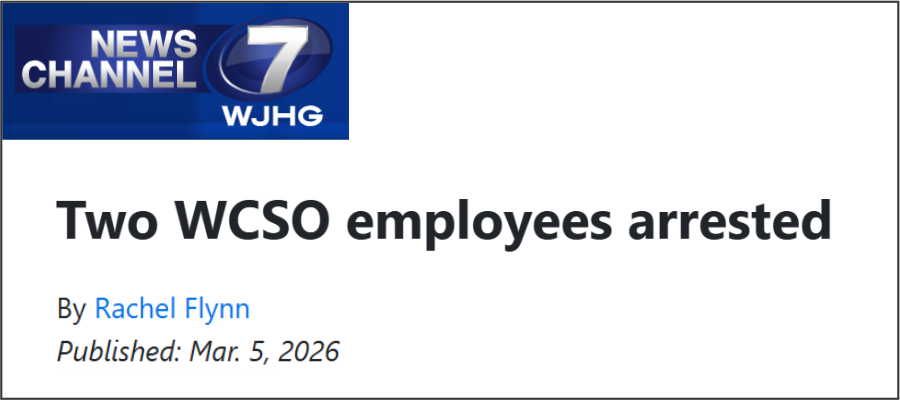
First, kudos to the only outlet I found that reported on both arrests in the same story, which really gives perspective. Nice job, Rachel Flynn: you didn’t ignore child rape.
I chose to include the dispatcher’s mug shot. I decline to publish Johnson’s. She has lost her job and deserves probation, not prison time.
Click the Titles to Expand
5 Mar 2026, 1:16 PM

WCSO DISPATCHER ARRESTED, FACES MORE THAN 50 CHARGES RELATED TO SOLICITING A MINOR FOR SEX
WALTON COUNTY, Fla— A Walton County Sheriff’s Office dispatcher has been arrested following a criminal investigation into reports of online exploitation involving minors.
In December 2025, the Walton County Sheriff’s Office received multiple CyberTips from the National Center for Missing and Exploited Children (NCMEC) regarding suspected online solicitation occurring over gaming platforms.
The information was linked to user accounts later identified as belonging to Jordan David-Lee Smith, 22, of Freeport, who was employed as a dispatcher with WCSO at the time.
WCSO investigators initiated a comprehensive criminal investigation. Subpoenas and search warrants were served to internet service providers and online platforms, digital records were reviewed, and electronic devices were examined.
Through the course of the investigation, Smith was identified as the individual responsible for using these accounts to solicit more than two dozen victims ages 11-17 years old for unlawful sexual conduct and to possess illegal digital material.
On February 24th, a residential search warrant was executed at Smith’s home, where multiple electronic devices were seized for forensic processing. On that day, Smith was terminated from his employment at the Walton County Sheriff’s Office.
The investigation’s findings were presented to the State Attorney’s Office, resulting in an arrest warrant being issued. Smith was taken into custody at his home in Freeport this morning, March 5th, and booked into the Walton County Jail without bond pending first appearance.
Jordan is charged with two counts of possession of child pornography, 25 counts of solicitation of a minor for unlawful sexual conduct, and 25 counts of use of a two-way communication device to facilitate a felony.
“The actions uncovered during this investigation are deeply troubling and represent a profound violation of the trust placed in anyone who serves this agency,” said Sheriff Michael Adkinson. “As stated before, our employees will be held to the highest standards, and when those standards are betrayed, especially in a way that harms children, we will not hesitate to act swiftly.”
– – –
Bad link? Broken image? Other problem on this page? Let Me Know, and thanks.
This page is an example of Randy Cassingham’s style of “Thought-Provoking Entertainment”. His This is True is an email newsletter that uses “weird news” as a vehicle to explore the human condition in an entertaining way. If that sounds good, click here to open a subscribe form.
To really support This is True, you’re invited to sign up for a subscription to the much-expanded Premium edition.
You are right on target with this. Most “news” organizations want to titillate, not to inform. Kudos to you and to Rachel Flynn.
The job of the press is to register eyeballs on ads, not to be “fair and balanced”.
—
But to get readers, they have to serve said readers. Yet so many don’t seem to understand that. -rc
I’ll take issue with your assessment on reporters. Your view on the newsrooms, led by editors and producers, is spot on.
“Yes, her arrest deserves coverage, yet all but one reporter focused solely on consenting adults and ignored a wanna-be child rapist.” And, “We have reporters questioning the judgment of law enforcement employees …while exercising horrible judgment in how they report those very stories. We end up with a condemning example of newsrooms no longer choosing stories based on public importance.”
You and I both know how stories get reported and how, more importantly, they don’t. I would assume most of those reporters, probably all, filed both stories back to their desks and that’s where the decisions are made — by editors and producers. Again, I am assuming; but, both you and I don’t know those details. And considering the seriousness of the pediphile charge, and considering those charges were alleged, maybe that’s why the editors stepped back. Who knows.
Don’t be so quick to take the reporters to task (unless you have inside info).
(Btw, I am a former video news photographer from NYC and have no love lost for a few reporters myself. We all became very frustrated with our management team from time to time.)
—
I would hope you have more insight into this than I do, but on the other hand it’s possible your insight is outdated — I don’t know when you retired from the field. It’s very typical these days that there are no editors, or if there is one, they’re horribly overburdened. Really, though, the mechanics of it are somewhat immaterial: the end result is obviously as described. So I’ll still accept your point that maybe the precise target of the essay isn’t focused enough and that maybe I should have left it at “newsroom” or “news operation,” though as far as I can tell, there isn’t a lot of oversight of the reporters’ choices. -rc
Thanks for not editing me to help fit a narrative. I hate to use the term fair & balanced but, oops, there it is.
—
Well, I can hardly invite comment and then edit it to put words into your mouth. I suppose some might, but they won’t last long, and there’s a reason True is nearly 33 years old now. -rc
I love your main point, and I agree with almost all the rest of this. But I still think it’s important to point out that sex between an inmate and a jail employee is NOT “between two consenting adults”; there is a power differential, as there would be between, e.g., a police officer and a civilian in custody. Yes, she is a food server and not a warden or guard. But if she claimed falsely that the inmate had assaulted or threatened her, she would likely be believed, and he would be punished. The inmate may have acted “voluntarily” in this case, but his situation precluded free consent—which is why her actions were criminal ones.
—
It’s a good point, but that sounds quite unlikely in this particular case. -rc