
A story in this week’s issue stirred up some emotions, taking me on a trip. I’d love to take you along with me.
Let’s start with the story, which ended the issue — a position I often use for a “feelgood” smile.
Quick Turnaround
Mercy Health Anderson Hospital in Anderson Township, Ohio, had a very sick baby boy who needed a higher level of care requiring transfer to Cincinnati Children’s Hospital. The problem: the terrible snowy weather, with wind chill as low as –25 degrees (–32 C). Cinci Children’s has a special ambulance for the job, but suspected it wouldn’t be able to get through the weather. They knew just who to call: the Ohio Department of Transportation, asking for a snowplow to respond to Children’s to plow a path through the snow all the way to Mercy — and back. ODOT’s Joe Estes had just arrived at work, and his boss told him the situation. “It’s probably the most important trek of my ODOT career,” Estes said, noting the roads were completely covered in snow. He set a target speed of 35 mph, but if the ambulance needed to go a little slower, he’d drop down to match it, trying to keep the ambulance within 150 feet behind him. “It was nerve-racking,” said respiratory therapist Heather Lipps, who rode in the ambulance to monitor the baby, identified only as Bryson. He made it to Children’s. (RC/WCPO Cincinnati) …Public Service done right: helping to clear the obstacles in life.
The story was really hard for me to write since I had tears streaming down my face, and it took me a bit to realize why. As I sat with it, it dawned on me: the story was stirring memories from my own EMS past.
Flashback Sequence
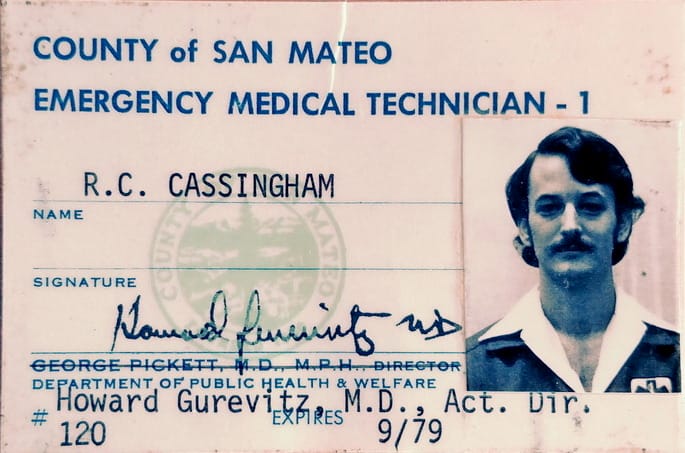
In 1978, early in my career as a medic, I was the EMT driver for a neonatal specialist paramedic who the company I worked for had hired away from the competition. The goal was to try to get some of that exact sort of transport business, so it’s a bit ironic that we never did transport a baby together. We did once transport a mother who was in extreme danger of delivering way too early, putting her baby’s survival at grave risk.
I remember some parts of that mission very clearly, other parts not at all — such as what hospital we picked her up from, and what hospital I drove her to, but it might have been in Marin County (the other side of the Golden Gate Bridge). I do remember we got her there without incident, because I can still recall the sigh of relief at the end.
That paramedic was pretty much a prima-donna bastard, but the nice thing about the gig was that he got the newest, best-equipped ambulance in the fleet. Such a nice ambulance that its manufacturer made a flyer with its picture, which I ran across when packing up. I scanned it before tossing it out. When I pulled up the scan I noticed a weird coincidence: it was built in Ohio.
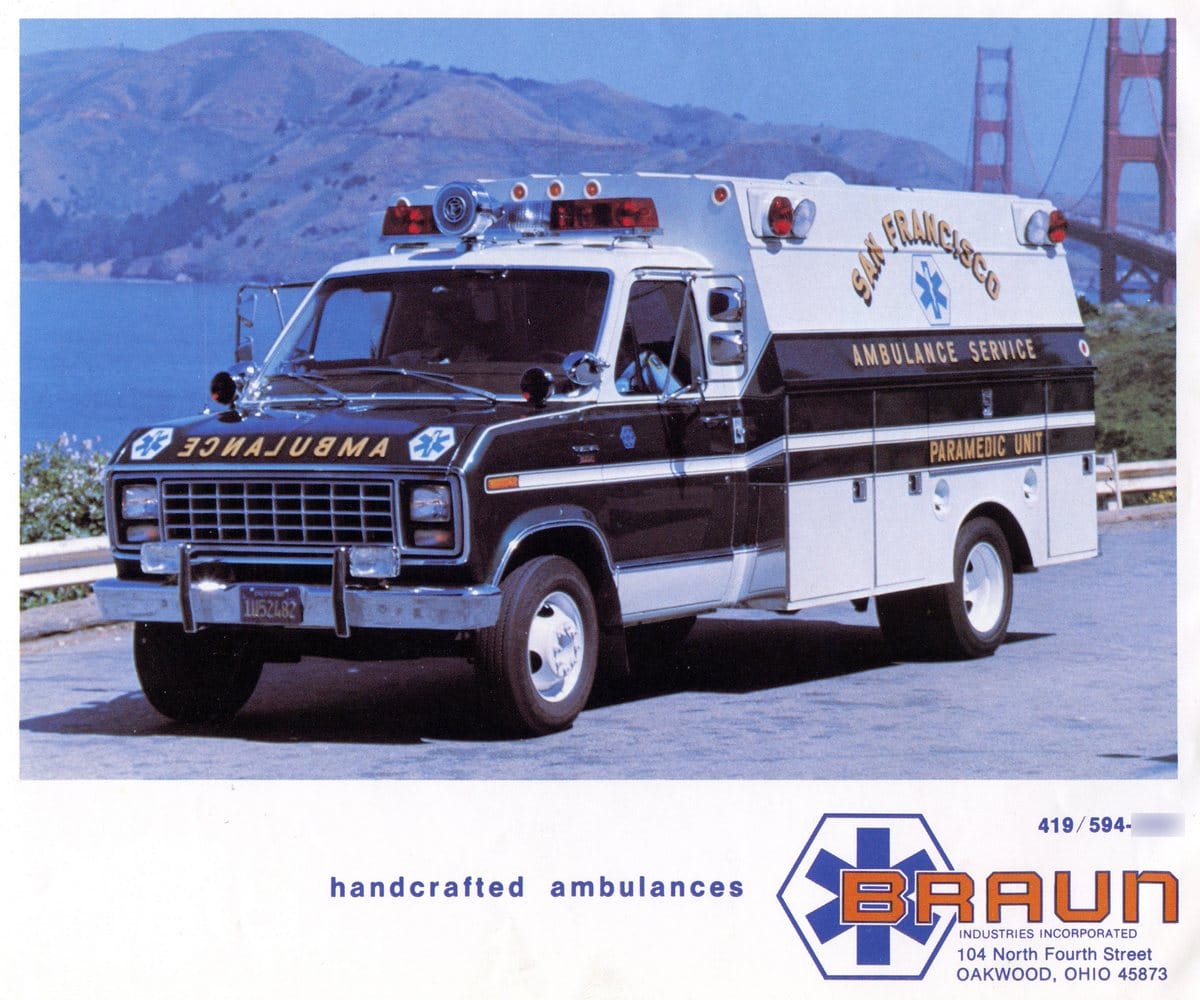
It appears that the ambulance is brown, but no: the “white” was a very light creamy green, and the dark a deep forest green. They were very handsome and distinctive vehicles. (Braun Industries)
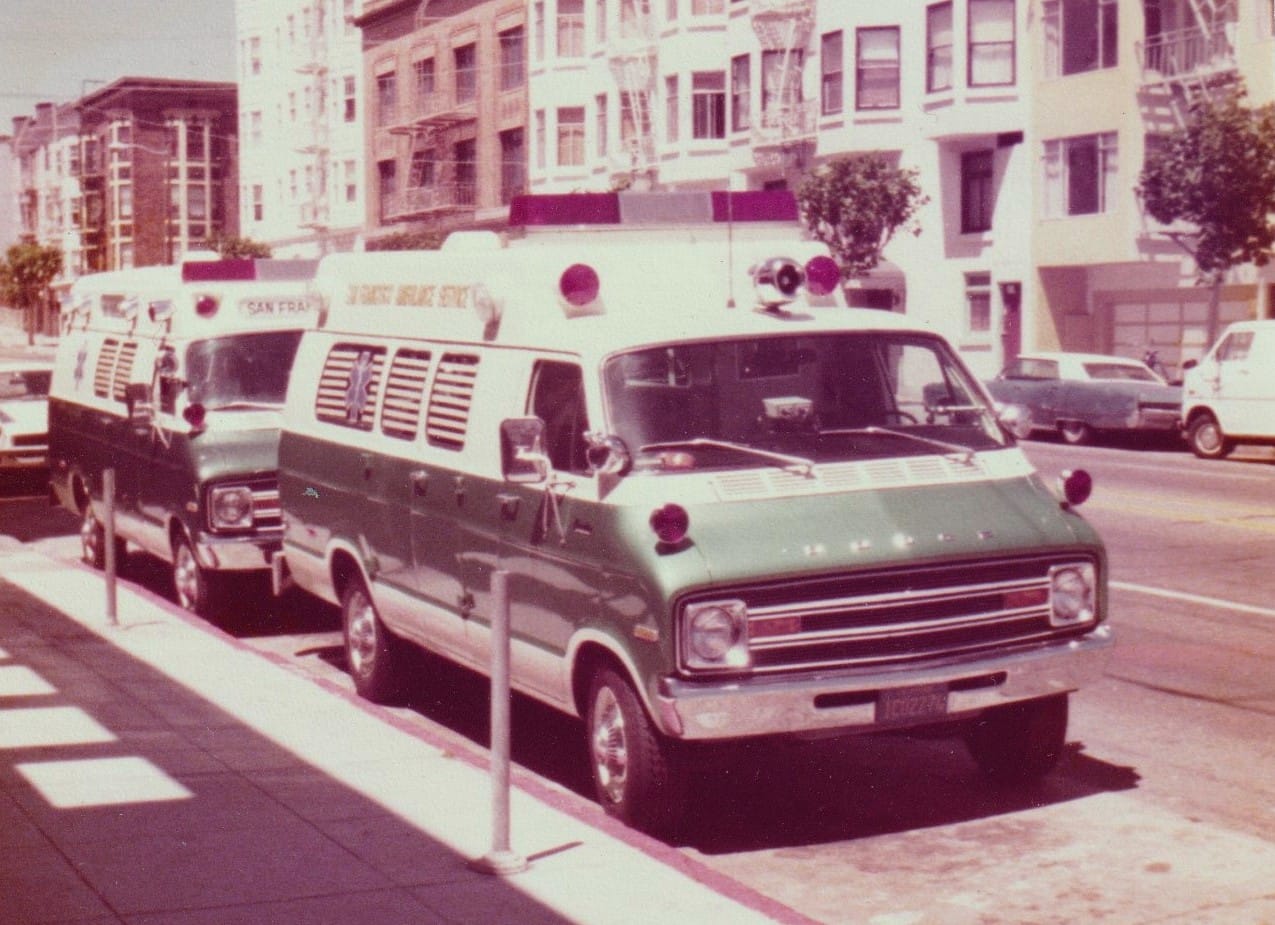
Here I was at age 19 with a reputation as a Go-To Driver for high-risk transports, and a short time later was tapped to “get here as fast as you can” to take a critical (adult) patient from Kaiser Permanente Hospital in San Francisco to Kaiser Redwood City, about a 30-mile run between the two …at rush hour. Though damn it, I wasn’t in that sweet ride of the big modular Ford that day, but rather in a Dodge van that topped out at about 70 mph, the dog! That was more than enough in The City (as all locals call San Francisco), but not great on a freeway.
Oh, and the Doctor is Going Too
The patient was in such rough shape that a Kaiser doctor went with us to help keep him alive. Due to the time of day, I judged that the best route to get through The City was via State Highway 1, a major north-south artery otherwise known within City limits as 19th Avenue, highlighted on the map, starting at Kaiser on Geary St.
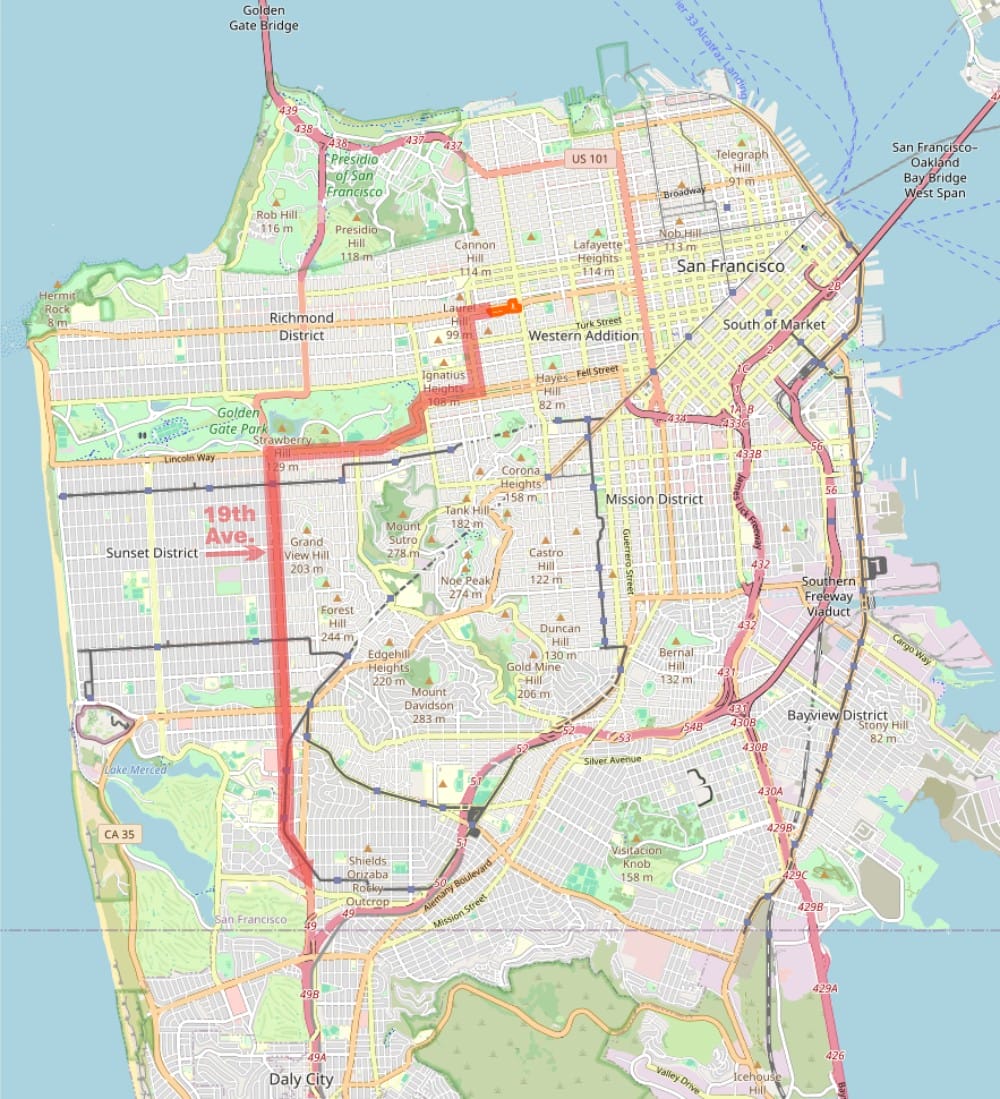
Those of you in the area likely know it well: three lanes in each direction with a traffic light on every corner and a concrete median between the sides the entire way, but with the blessing that the lights were all beautifully timed so that if you could get up to the speed limit, you could just keep going all the way through town. But being afternoon rush hour (read: traffic mostly going south), I couldn’t possibly get up to speed unless I did something a bit radical.
Like what? Well, it’s an ambulance! I went the wrong way down 19th Avenue, sirens blaring, until I got to the next light where everyone was stopped, including the wide-eyed drivers I was facing, switched over at the next intersection to take advantage of the now empty lanes in the correct direction down to the next light and caught up with traffic again, then cut back over to the wrong side, and repeated until traffic loosened up enough to slide onto Interstate 280 at the south end.
That patient survived too, and then we had to take the doctor back to the source: a round trip just like in the above story. That was the first time the fairly young doctor had a chance to talk to me, and he had something to say. “When I looked up from the back,” he said, intently looking me directly into my unflinching eyes, “and saw we were going the wrong way down 19th Avenue…” (I started to grin) “…I knew this was For Real.” He then smiled, jumped into the back, and settled in for the leisurely ride home.
My impression of that doctor as “young” almost certainly meant he was in Residency, or soon after, making him around 30. It’s a bit mind-boggling to consider that he’s thus certainly now well retired and approaching 80.
That wasn’t the only high-risk interfacility transport I drove in San Francisco, but it was definitely one of the more memorable.
Good luck, Bryson. Hope you grow up to do service for humanity too. And maybe you will find this story someday, when I’m well retired and approaching 90.
– – –
Bad link? Broken image? Other problem on this page? Let Me Know, and thanks.
This page is an example of Randy Cassingham’s style of “Thought-Provoking Entertainment”. His This is True is an email newsletter that uses “weird news” as a vehicle to explore the human condition in an entertaining way. If that sounds good, click here to open a subscribe form.
To really support This is True, you’re invited to sign up for a subscription to the much-expanded Premium edition.
Had one of the worst callouts of my career just over a week ago — single vehicle MVA, 2 thrown from the vehicle, CPR being performed on both of them. The first one was called fairly quickly due to massive blood loss, and the second one came back briefly with an AED, but wasn’t able to sustain rhythm and was called shortly after. The driver was taken to a trauma unit under guard, and has been charged with reckless driving causing death. Everyone involved — VICSES RCR responders, ambos, firies and police — were thorough professionals throughout, and we were supported brilliantly by our unit management at the scene, and in the aftermath. If you know someone in the emergency services, give them a hug — it may be what they need.
—
I’ve been there, brother: I get it. GREAT to hear you’ve been supported so well: as you probably know well, that used to pretty much never happen. “Suck it up. Next!” was the attitude.
For others: MVA = Motor Vehicle Accident. “called” = pronounced dead. VICSES RCR = Road Crash Rescue unit of the Victoria State [Australia] Emergency Service. Australian SES teams are volunteers. Ambos = Ambulances, firies = firefighters. -rc
My youngest brother served as an EMT in Wright, WY, back in the 80’s. They had just cleared the hospital in Gillette when dispatch called to make a STAT run back to Wright. Al was driving, so he asked for clarification. He was told the sheriff was in a “man with a gun hiding in a house” situation and wanted the ambulance there NOW!
My brother claims he made the 36 miles in 18 minutes. He checked in as soon as he cleared the city boundary, only to be told he could “stand down” as the sheriff had “resolved the situation”.
—
That’s known as “staging” an ambulance nearby, just in case. Went on many of those, and right off I can only think of one that went tragic (cop was fine, baddie shot himself in the head right in front of the cop). We had been requested but weren’t even rolling yet — it can happen very fast. -rc
When you said the ambulance was made in Ohio, I figured it was a Braun. They moved from Oakwood to Van Wert, Ohio (where I live) several years ago. They have a good reputation here both as an employer and as a corporate citizen. They donate a new response vehicle, basically a modified ambulance, to the local CERT organization every few years. When there was a local Red Cross organization, they donated an ERV to them. It makes a huge difference having someplace to take a fire victim that’s warm & dry, or to allow firefighters to melt the ice off their gear during winter fires.
—
I didn’t research it, but it’s great to know they’re still operating after all these years. What you present here is probably a big factor in their longevity. -rc
Unit 107 looks a lot like a work van, like an electrician or Ma Bell crew would drive.
The Ohio story reminded me of a bit of glurge I remember reading years ago (I think in Reader’s Digest). A cop was responding to a non-breathing child (because he was closest) but couldn’t reach it because of a construction zone even though he could see the house from the freeway. He supposedly told a worker on a bulldozer what the issue was, and the dozer driver then cut a very direct path to the house. The story went that it was the dozer driver’s home.
—
A little far-fetched. Though I’m quite confident in the Ohio story: several independent people were interviewed for it. As for the “work van,” that’s what it is: it all depends on the internal components, and you can trust me that it was terrific. We even had the ability to load an incubator. -rc