
There’s one more story in this week’s issue that I’m publishing separately as I’m starting to dislike the source, and because I want to explain why I’m disliking it, in an editorial. First, the story:
Self-Inflicted
Glen Lee Ong, 78, was “fired” by his doctor: Ong admits he drank water before a procedure, presumably against the doctor’s orders. When the unnamed orthopedist found out, he canceled Ong’s surgery. It apparently happened before: “That guy screwed me over twice,” Ong told police in Wildwood, Fla., then downplayed the reason: “I was already dressed up to do the surgery, and he called it off just because I had a sip of water.” But that statement was made after he denied knowing the doctor, and denied the pickup truck in security camera video was his — see? His didn’t have the lettering on the back window that the photo showed. Police found residue where the lettering had been, suggesting Ong had removed it. Police were involved because someone wearing a surgical mask had parked a red truck near the doctor’s Tesla, got out, and hit the car’s windshield twice with a hammer, causing $1,600 in damage. Caught in his lies, Ong allegedly admitted he thought the doctor “needed to be held accountable for his actions and that he wanted to teach [him] a lesson.” (RC/WKRC Cincinnati) …Says a guy who administers “lessons” with a hammer.
Kind of a typical True-like story, yes. Yet there is more than meets the eye, and wait until you see what met my eye.
What About the Source?
First, anyone who enjoyed the classic 1978-1982 TV show WKRP in Cincinnati, including me, can’t help but be charmed that there’s a real station in Cincinnati doing the news (though not with Les Nessman) with the oh-so-close (and rhyming) call letters WKRC.

Yet they seem to spend more time covering news outside their coverage area to drive clicks to their site by rewriting news stories from other outlets: most of the stories I see in my feed from WKRC aren’t even based in Ohio, let alone in their market area.
There’s really nothing wrong about that as long as they’re serving their audience — I do it every week, though not to drive you to my site to see a bunch of ads: the stories that appear on True’s site don’t have ads next to them, and neither does any other page on the site, which is supported by Premium subscriptions, not ads.
Make It to Fake It
So what’s the problem? Faking the evidence. WKRC is a TV station and they really feel the need to have visuals with every story, especially since the image is then set as “featured” on the resulting web page, and when that page link is posted to social media, a shocking or interesting photo attracts “eyeballs” and thus more clicks.
The best photo to accompany this particular story, of course, would be from the security camera showing a man wearing a surgical mask swinging a hammer toward the Tesla, with a red truck (with lettering on the back window) visible in the background. Alas, the cops didn’t release that, or apparently any other, photo.
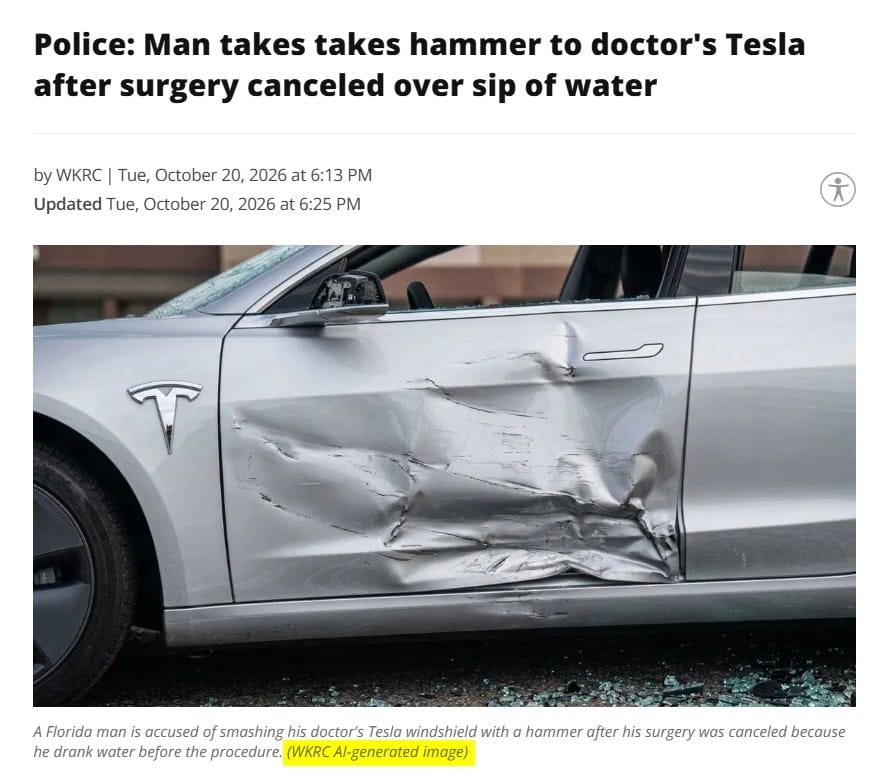
It doesn’t show a couple of gnarly “stars” on the windshield, and in fact the windshield isn’t even shown! Rather, it’s a side view rendering of a silver Tesla Model 3. The driver’s side mirror is smashed. The driver’s window is in thousands of pieces. The door and the rocker panel below it are horribly crumpled by …we’re not sure, but it is obviously not hammer blows. Instead of the standard side camera between the door and the wheel well, there’s a massive, out-of-place Tesla logo.
The doctor’s car isn’t described in any of the coverage I’ve read: is it even silver? Is it even a Model 3? Who cares? The gigantic logo makes it clear it’s a Tesla! Run it!
News in the A.I. Era
Indeed WKRC did admit, in very tiny type below the photo on their site, “WKRC AI-generated image.” — a disclaimer that cannot be seen in the social media posts bringing people to the page.
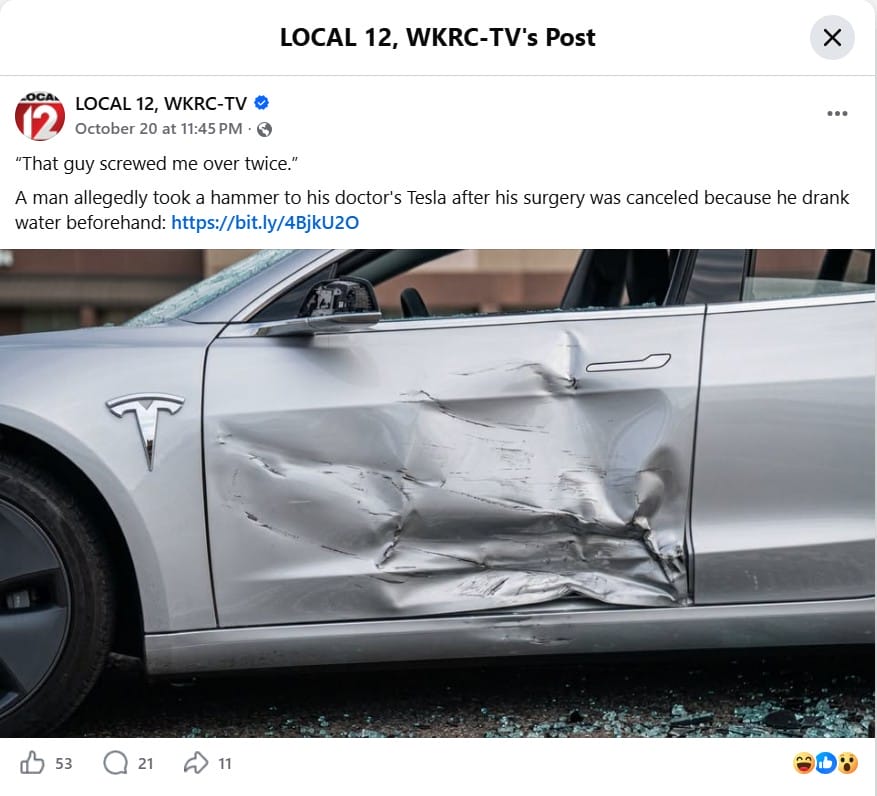
They created a misleading visual representation of a real incident, presented it in the visual position normally occupied by documentary evidence with a serious news story, and distributed it in contexts where the disclaimer wasn’t visible. Slapping an inconspicuous “AI-generated” label on it doesn’t excuse using it to illustrate damage that never happened.
This is in the middle of a massive public backlash against “A.I. slop,” and this is some of the sloppiest. Not just sloppy A.I. output, but sloppy journalism. When the news industry is under fire for making stuff up, WKRC goes and …obviously makes stuff up. Great job, guys: make it harder for the entire industry to be taken seriously. It’s garbage and you know it.
Really, my slug on the story, “Self-Inflicted”, doesn’t just pertain to Mr. Ong: WKRC scored a massive own-goal for the entire news industry. It’s not deliberate deception, it’s reckless indifference to accuracy.
Worse, It’s Betrayal
The betrayal of the reader’s reasonable assumptions, I mean. Yeah yeah, sloppy journalism undermines confidence in the news media. But readers have an implicit contract with every news organization they visit: when a photograph accompanies a factual report, they reasonably assume it depicts something relevant and authentic, unless it’s obviously an illustration.
WKRC exploited that assumption. It didn’t simply fail to meet readers’ expectations; it used those expectations to make its story more compelling, more clickable, and to hell with accuracy. Readers shouldn’t have to investigate whether a news organization is telling the truth about its own presentation of the news. That’s the organization’s very job.
The tiny disclaimer doesn’t solve that problem. It transfers the burden of verification from the publisher to the reader, while the publisher enjoys the benefit of the misleading image by the very click landing the reader on the page.
Even when a news outlet publishes a factually accurate article, as here, it can still be untrustworthy in how it presents that article. WKRC didn’t need to fabricate a single word of the underlying news story to deceive its readers. It did that in a much more insidious way. It’s beyond A.I., the oh-so-easy tool used to commit the fakery. It’s about the editorial judgment that allowed it.
The obliviot in the story thought his doctor needed to be “held accountable for his actions.” WKRC conveyed that part well, without even considering that it actually applies to themselves, too.
A.I. didn’t make WKRC abandon its editorial judgment. A.I. just made it easy to not exercise it.
– – –
Bad link? Broken image? Other problem on this page? Please Let Me Know using the Help button in the lower right, and thanks.
This page is an example of my style of “Thought-Provoking Entertainment”. This is True is an email newsletter that uses “weird news” as a vehicle to explore the human condition in an entertaining way. If that sounds good, click here to open a subscribe form.
To really support This is True, you’re invited to sign up for a subscription to the much-expanded Premium edition.