
More on a story from this week’s newsletter. Let’s start with the story:
His Proud Moment
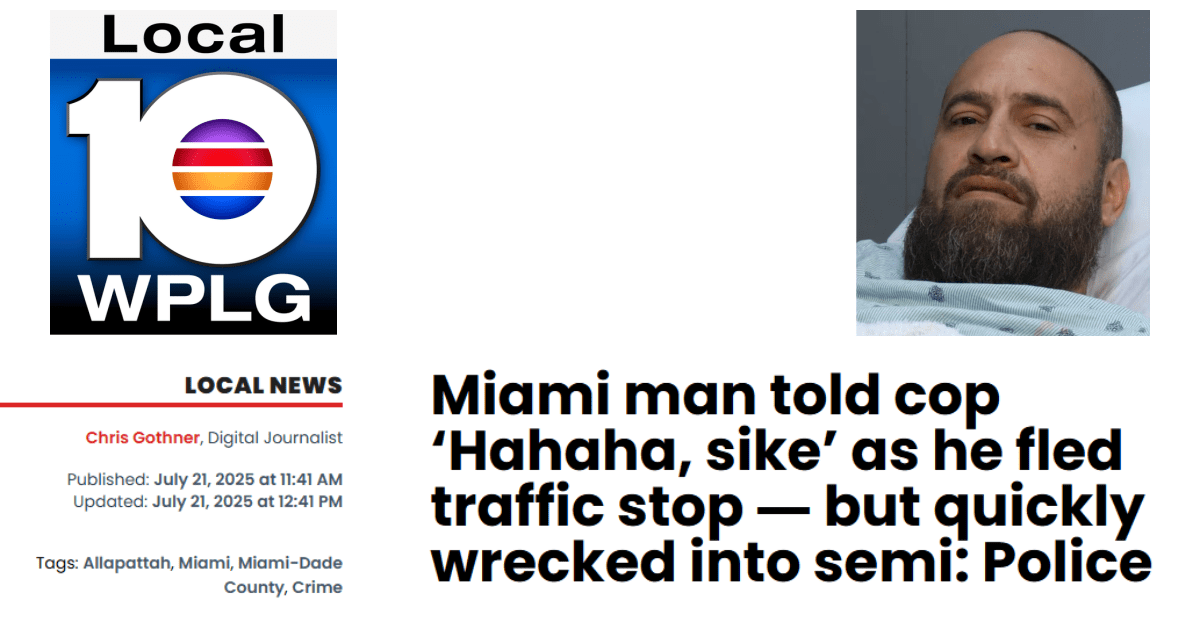
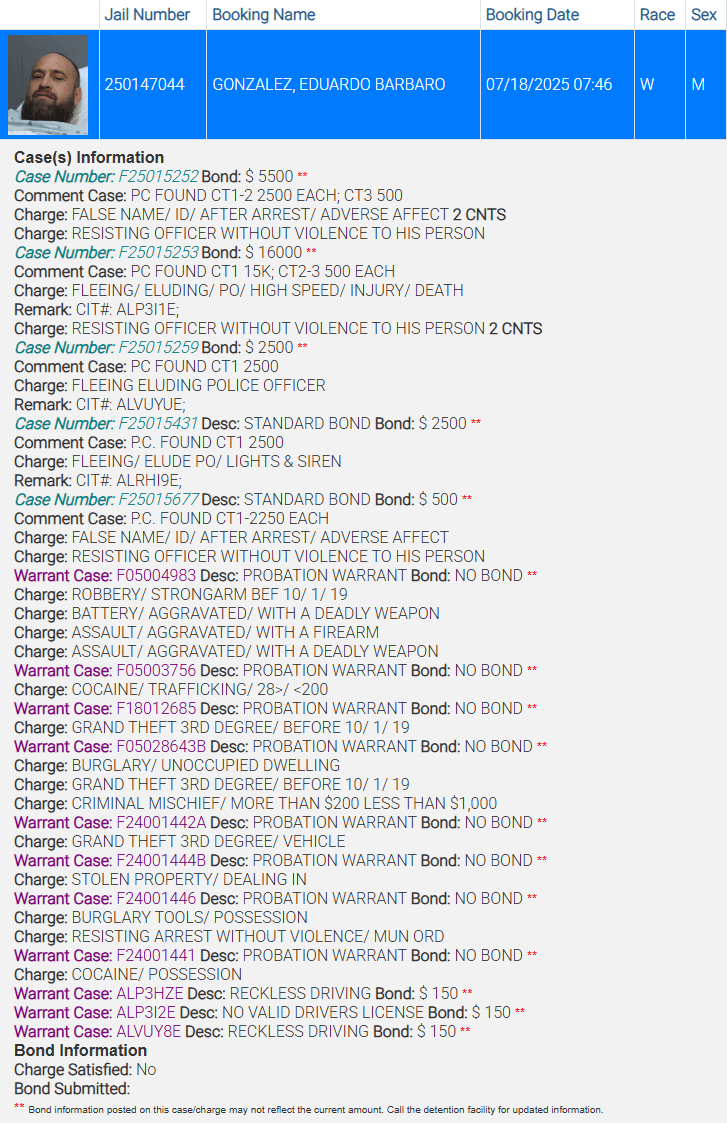
Police in Miami, Fla., pulled over a man after an alleged drug deal. “I moved my vehicle in front of his vehicle and lowered my window to talk to him,” the officer wrote in his report. “Are you trying to come in?”, the man said, perhaps not realizing he was speaking to a cop. “No, I need to speak to you. You aren’t free to leave.” The man said “Hahaha, psych!”, sped off with his tires squealing, ran a stop sign — and slammed into a passing semi. The man got out and tried to run, but was “hobbled” by an injury. He was quickly caught and arrested. Eduardo Barbaro Gonzalez, 42, had multiple warrants for his arrest. He was treated at a hospital for minor injuries and then jailed, and with so many serious charges he hasn’t been able to get bail. His mug shot was taken in the emergency room: he’s lying on a bed wearing a hospital gown. (RC/WPLG Miami) …He has clearly never worn a graduation gown, so at least he got that one.
Siked Out
When I was a kid, one of the fun ways to yank someone’s chain was to feed them reassurance — or a whopper — and then pull the rug out with a triumphant “Psych!” You didn’t just trick them — you psyched them out. The “psych” comes straight from psychology, and was the mental game of getting inside someone’s head to make them feel dumb.
But somewhere between then and now, the meaning — and spelling — got garbled.
WPLG’s Headline
The headline on the my source story [direct, archive] from WPLG in Miami, illustrates the shift (image above). [Full Disclosure: WPLG claims the mug shot is “Copyright 2025 by WPLG Local10.com – All rights reserved.” Since this is a police mug shot, I do not recognize this specious claim.]
Hell, they not only misspelled it, they missed an important component: the ! at the end. It’s a loud taunt, not a whispered insult.
It’s not the first time I’ve seen this. In the last couple of years I’ve noticed several people — well, reporters — spell it “Sike!” Which makes absolutely no sense …unless you have no idea where the term came from. A whole generation picked it up by hearing it, not seeing it in print, and figured “sike” must be right because, hey, that’s what it sounds like.
Sike really is a word: it means a small stream. Is that what they really think this obliviot is saying to the cop?
It’s the equivalent of writing “mute point” instead of “moot point” and insisting that’s fine because “that’s how everyone says it.” It sort-of works phonetically, but it’s completely divorced from its actual origin. (Moot means open to debate; it’s from the French Old English for a meeting, where there are often debates. It’s about talking, rather than not being able to talk. Meaning: lost.)
“Sike” isn’t about psychology. It’s just a noise reporters think Florida Men make instead of “Gotcha!” when they run away giggling — and slamming into a semi.
Which is exactly why the spelling shift is stupid: the mental-game connotation is gone. “Psych!” was about outsmarting someone. “Sike!” is just childish taunting; the cleverness has been lost in translation. Florida Men (and to be sure, the reporter here is one) may say “Sike!”; bright folks say (or write) “Psych!”
Spelling matters: it often carries the history of the word, and adds layers of meaning. Plus, using the right spelling feels a lot more satisfying — especially when you’re smart enough to know the difference.
– – –
Bad link? Broken image? Other problem on this page? Let Me Know, and thanks.
This page is an example of Randy Cassingham’s style of “Thought-Provoking Entertainment”. His This is True is an email newsletter that uses “weird news” as a vehicle to explore the human condition in an entertaining way. If that sounds good, click here to open a subscribe form.
To really support This is True, you’re invited to sign up for a subscription to the much-expanded Premium edition.
My former spouse worked for WPLG for many years; he retired a few years early in disgust when they got too dumbed down for him to tolerate. He said he just couldn’t do it even one more day.
Another one that irks me is “walla” for “voila”. Again, no concept of meaning or origin.
—
A programmer at JPL asked me to edit a paper he was presenting at a conference. He had written it as “wahlah”, and I couldn’t believe it. Now I’d believe anything. 😉 -rc
This is clearly how the town of Walla Walla Washington got its name: When the first French Canadian explorer saw the location and realized it was the perfect place to build a cabin, they excitedly shouted “There it is! There it is!” Their fellow travelers didn’t speak French, and so….
You are ever so correct — “Spelling matters: it often carries the history of the word, and adds layers of meaning. Plus, using the right spelling feels a lot more satisfying — especially when you’re smart enough to know the difference.” I wish I could convince my 16-year old grandson of that (I can’t because he already knows everything). Thanks, and keep up the great work!!
—
Start him on reading some fun This is True stories …and once he gets into them because they’re funny and real, send him to this page. -rc
I think the worst spelling issue besides the obvious, there, their & they’re is that we are loosing the proper use of the word “lose” which means “not firmly fixed in place”. Sad. 😉
—
I’m hoping you were being ironic in your misspellings…. -rc
Absolutely! In both cases. (Big Grin)
—
Whew! -rc
I wonder what age of people switched to writing sike? I’m 43 and definitely still write PSYCH! 🙂
I’ll admit that I always saw it written as “sike” until relatively recently (I’m 35), but once I found out what it actually meant I realized (even before I saw it written down properly) how it was supposed to be spelled.
I understand how you feel about it, though, because the generation below me has a word that they constantly misspell (at least on Tumblr) and I want to reach through the screen and shake them every time I see it. The word is “sweetie”, as in “sweetie-pie” or “sweetheart”, and I can only assume that people don’t realize that and assume it’s just a nonsense word, because there is NO LOGICAL REASON to think that just because it rhymes with “meaty” means it should be spelled the same way….
—
Hah! Yes, sweaty means something very, very different. 🙂 -rc
My elder brother told me, “Don’t pet the sweaty stuff.”
A friend of my sister, back in early internet days, had several personas on an AOL meet-up site. She was proudly showing them to me one day when I saw “Chicago Sweaty” on the list of personas. I started laughing and she said “Yeah, I never get anything but perverts on that one.” I said, “Well, it’s kind of an invitation to creeps.” She said ‘Chicago Sweetie’ invites perverts?” I said, “No, but ‘Chicago Sweaty’ seems on the nose for wankers, don’t you think?” Then she called me and idiot, insisted it was “sweetie”. I just shrugged. If I’d had a Get Out of Hell Free card, I’d have awarded her one.
—
She wasn’t an idiot. She was an obliviot: oblivious to why she was wrong because she “knew” she was right, and therefore the target of well-deserved laughter. -rc
Obliviots appear to be increasing exponentially with each passing year in the US. Which has caused me to be far avoidant of interactions with my fellow human beings than ever before — as I always remember the (implied) moral of the story “The Country of the Blind” (H.G. Wells): be careful when trying to enlighten those who are happily oblivious, lest they poke your eyes out.
The one that really grinds my gears is “honed in on” instead of “homed in on”. You see this all the time and it’s usually written by someone who is well educated that should know better. Perhaps spell check is the real culprit here, I don’t know. What I do know is that honing, ie: sharpening or fine tuning is a far cry from nearing one’s target by homing in on it.
—
To “hone in on” is quite valid. -rc
“3 (hone in on) [no object] another way of saying home, (see home): the detectives honed in on the suspect | I started to hone in on the problem.”
Dictionaries used to be the foundation of language. Now even the OED will print any usage, no matter how derived. “Hone in on” was not proper English when I was in college. It is now, because English is no longer taught, save by what people think they hear, but do not know how to spell. After all, we have spell check, now, so why should they? “Sike” will be entirely proper, by the same mechanism, within a few years. Relie upon it.
(And if you cannot see and hear the molten irony dripping from this, you may be going def and siteless.)
I agree with you, Phil, and disagree with you, Randy. Just because a misuse has become popular doesn’t render it an aceptable use. I think a more authoritative source than the Free Dirctionary would be Merriam-Webster, for American (USA) usage.
—
*shrug* Even OED lists hone in, going back to 1965. I don’t know if there are usage examples before that or not. -rc
People who don’t understand that “hone in on” is a proper expression have never worked on engine rebuilds or other precise machining.
If there was an example before 1965, the OED was unable to find it, because they always include the earliest reference they can locate. I did a Google Books search, and “honed in” was still extremely rare until about 1980. (I eliminated all the matches where Hone was a proper name, and also where hone and in were not used as a single phrase).
One of my favorite memes says “Those who mistake burro for burrow don’t know their ass from a hole in the ground”.
People who can’t distinguish between etymology and entomology bug me in ways I cannot put into words.
Carefully considering your choice of appropriate words in professional journalistic articles is, like, uh, important, uh, and stuff?
—
Um, uh huh. -rc
So many people assume that everything is spelled the way they hear it or say it. There’s a formation at a local ski area called “Bomber Bowl,” because a WW II bomber on a training flight crashed on the mountain many decades ago. Lots of people call it “Bummer Bull.” Of course, it would be a bummer to crash a plane on a mountain….
And there’s people who “flush out” the details instead of “flesh out”. (Though I suppose that if the details are hiding in the bushes you might flush them out.)
BTW, “moot” means both “suitable for discussion” and “no longer relevant for discussion”; in modern usage I would say that a “moot point” is usually one that is not worth discussing because the matter has already been settled.
And I just happened to stumble upon some documentation that said that something would “peak through” (vs “peek through”).
This discussion could go on for a very long time….
—
Yeah, though I’d prefer the comments were talking about the phenomenon and what it means, rather than simply give examples. -rc
It seems like there are a couple of separate but related issues:
Spelling reform would drive me kuukuu, but would be good.
If we could pry apart words that are too similar, replacing one of them, that would be good.
But as for the rest, grr, get off my lawn, you young rascals!
—
A lot of it goes back to the “melting pot” history of English. We readily adapt words, phrases, and ideas from other cultures, so yes, we’re going to have an omelette, not an omlet. The rich heritage is part of the beauty of the language. -rc
“The problem with defending the purity of the English language is that English is about as pure as a cribhouse whore. We don’t just borrow words; on occasion, English has pursued other languages down alleyways to beat them unconscious and rifle their pockets for new vocabulary.”
― James D. Nicoll
I think the misspellings in discussion are similar to other long-term usage changes. Each of the little green things in a peapod is a pea, but originally the word was ‘pease’. That is, each little round green object was a pease. The word ‘pea’ is a backformation, likely rooted in the fact that ‘pease’ sounds like a plural noun.
There are many instances of words changing their spelling over time. The Brits (and Canadians) think Americans are dumb for misspelling ‘colour’, and there are many other shifts of that sort between British usage and American usage. Neither group is wrong. When faced with the question ‘is it color or colour’, the only good answer is — both!
Spelling is important, and several of the examples in comments to this article are absolutely on point. But ‘for all intensive purposes’, many of these misspellings are now in such common usage that they will eventually appear in the dictionary as proper usage.
On the subject of backformation from apparently plural nouns, many years ago, the manager of our local camera store would talk about getting a new len for a camera — just one len, not a set of lens.
—
If he didn’t know that the thing attached to the front of a camera had multiple pieces of glass in it (lenses all), then he was not qualified to be an employee of a camera store, let alone the manager. Sheesh! -rc
I’d be curious to hear your opinion on American variations of spelling. I’m constantly told words like armour or specialised are misspelled by my computers, and although I stick to the spelling I’m familiar with, I can see the reasoning behind the changes.
Would you advocate keeping traditional spelling because of the links to old French, or does there come a point where simplification becomes preferable?
—
I’d guess your computers are set to American English, then. It “should” tell you that armor and specialized are misspelled. For Windows 11, for instance, there are multiple variants of English that you can set, for Australia, Belize, Canada, Caribbean, India, Ireland, Jamaica, Malaysia, Maldives, New Zealand (ding ding ding ding!), Philippines, Singapore, South Africa, Trinidad and Tobago, UAE, UK, USA, and Zimbabwe. -rc
Another miswording that regularly irks me is sell vs sale. Here in Oklahoma, I constantly see people on FB Marketplace saying they have a “car for sell” or they’re trying to “sale a car.”
It hurts my head.
Given the context, I think it’s ironic that I pull you up on a point of etymology, Randy. ‘Moot’ Isn’t French, it’s Germanic in origin, from Old English (Anglo-Saxon).
Right, time to put my alter ego Mr Picky back in his box!
—
Good catch! That might have come from ChatGPT when I asked it for some good examples of word/phrases that get misused (but I should have checked it). It’s indeed most directly from Old English: “[Old English gemōt; compare Old Saxon mōt, Middle High German muoze meeting]” says Collins. I’ve fixed the text above in a way that preserves the error. -rc
Languages evolve and that evolution is impossible to stop. Knowing that doesn’t stop the cringe when I hear or see the bastardizing, um, I mean evolving, in real time. If an archeologist were to find texts from 1700, 1800, 1900 and 2000 and there were no physical differences — yes, that would be ridiculous because bookmaking has substantially changed — they would have no trouble dating them by the spelling, word choice and sentence construction. Pretty prithee try not to judge.
—
I’m not talking about evolution here, like verbinizing a noun, I’m talking about not understanding a concept and using a completely wrong word. You could have said “Pretty prithee try not to mudge.” You might think you know what you meant, but no one else would know what you meant. It comes down to communicating (you instantly understood what “verbinizing a noun” meant) …or not. -rc
I see weary for wary a lot, no one ever pumps the breaks in real life and I totally agree on the moot vs mute. No one knows how to spell anymore and autocorrect is making it worse in my opinion.
I can’t believe that no one has suggested listening to Weird Al’s song “Word Crimes.”
—
It is indeed brilliant. Here’s a live version. -rc
Thanks for the link. I hadn’t seen the live version. My wife bought me tickets to his show next month for our 29th anniversary.
—
Cool! I’ve never seen him in concert. -rc
When I was a kid, we used to exclaim “psych out!” with the exact same meaning as today’s “psych.” Perhaps that is the lost etymology.
One example that always annoys me is an episode of Futurama — generally a well written and literate show, which incorporates a large number of mathematical and scientific concepts in its writing — in which the expression “my interest was piqued” was subtitled on the DVD as “my interest was peaked”. And I think in this case it’s because whoever was doing the subtitling simply didn’t know the word.
But I’ve started seeing these sorts of errors far more frequently since I got a Kindle and started reading hundreds of free or cheap books. Homophone confusion is rife, and even those books which credit an editor are not immune (though they are usually at the better end of the range). There are books that I was glad to finish reading because the author had a pet phrase that they kept mangling.
I have to conclude that the issue is people growing up with far more media consumption via listening or watching rather than reading. Yes, as a reader you’ll still encounter errors, but you’ll see it spelled the correct way much more often. At least if you stick to physical books and not Kindle freebies….
Arthur C. Clarke once wrote about a thought experiment involving the English language: Get a long table, and seat yourself at one end. Seat your father next to you. Seat his father next to him, and so on down the length of the table until you had a hundred generations of your ancestors all lined up. Each person could to talk to the person on either side of themselves with perfect clarity. However, walk twenty chairs down the line and you would struggle to communicate with even simple sentences.
These always leave me shaking my head:
For all intents and purposes = For all intensive purposes
Hook and lateral = Hook and ladder
Flustered/Frustrated = Flustrated
The misuse of modifiers with the word unique also drives me nuts. Nothing can be very unique, it’s either one-of-a-kind or it isn’t!
Unique
adjective
being the only one of its kind; unlike anything else.
“this discovery was unique in history”
While it’s technically true that “unique” means one-of-a-kind, if you look closely enough all physical things are unique. There are no two things that are absolutely identical. What we really mean by unique, therefore, is that it’s *significantly* different from other things. You can certainly measure *how* different it is from other things, and so you can say that something that is more different from other things is more unique.
—
I actually like that explanation. Even those who don’t agree with it should at least admire that it shows some thought behind it. -rc
Well this post led to an interesting discussion and a discovery: we live in a divided home!
I grew up learning the spelling “psych”, but my wife has always spelled it “sike”. It seems to be a regional/local thing, as all her friends and family members from the same generation (late Gen X) spelled it the same way. Some surface-level online research points to this being a common thing in the Northeastern US in the 1980s.
Language does evolve and dictionaries are descriptive, not prescriptive. So I may have to admit it’s not exactly wrong, just different.
—
Interesting! Though (cough), “sike” is still wrong. 😉 -rc
I would appreciate if someone who uses the spelling ‘sike’ would explain where it arose and why they spell it that way.
I agree, Mike. I have never in my whole life seen it spelled that way until I saw Randy’s post.
Another obliviot example is confusing weather, whether and wether. Wether is the simplest spelling re pronunciation but it actually is the term for a castrated ram or billy goat and is the root of bellwether — the one fitted with a bell.