
Artist Richard Ankrom kept getting mixed up when driving a certain section of the L.A. freeways, so he took it on himself to fix the problem — and make it a performance art project at the same time.
It succeeded exactly as he had hoped: everyone, including the California Department of Transportation, thought it was a “legit” change in the sign. From the 12 May 2002 issue:
Give Me a Sign
Richard Ankrom, 46, an artist in Los Angeles, Calif., planned his latest masterpiece, a combination paint and performance work, for two years: he altered a major road sign on the Harbor Freeway in downtown. He put up his work in broad daylight, but was unnoticed because he was dressed as a road worker. The audience: 150,000 motorists per day. The payoff: no one noticed, not even state transportation engineers. The plan was to announce the project a year later, but a friend tipped off the press after 9 months. The modification, done to exact Federal Highway Administration specifications, helps motorists navigate a complicated transition ahead. “The experts are saying that Mr. Ankrom did a fantastic job,” said a Caltrans spokeswoman. “They thought it was an internal job.” The agency plans to leave the modification in place, since it is in fact helpful to motorists. Ankrom says helping out motorists “was the whole point.” (Los Angeles Times) …If You Want Something Done Right, Do it Yourself — Industrial Division.
The best part: Ankrom supplied a “time lapse” photo of himself doing the work:
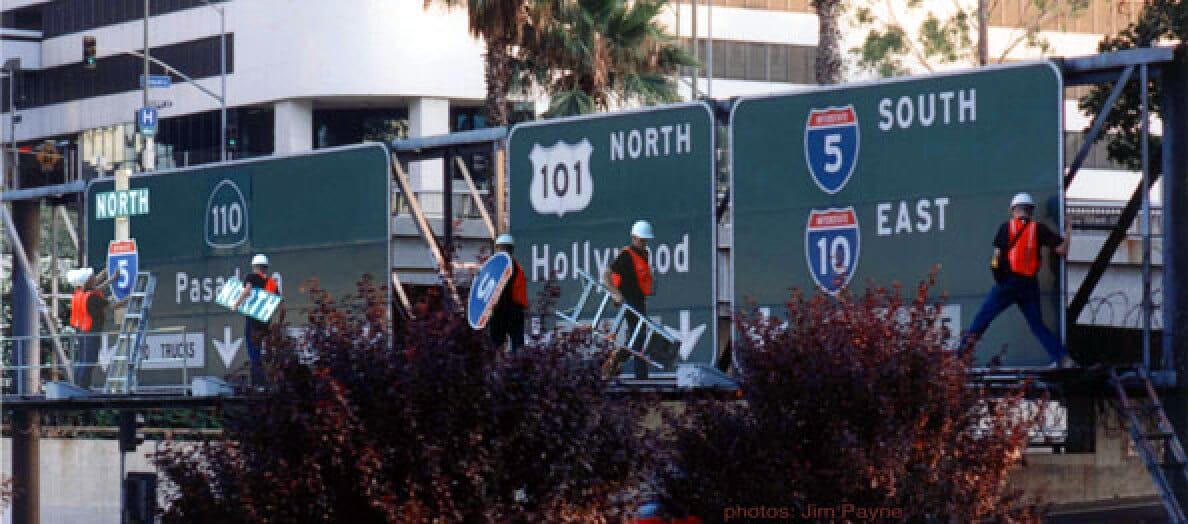
Ankrom is, in fact, a sign-painter by profession.
– – –
This page is old enough that when published, the site didn’t have the ability to accept comments. But I remember a reader emailed to say that said I was dumb to say that “All six people shown in the photo are Ankrom” because there were only five people in the photo. If you click it to make it larger, you can see the one at the far left has two helmets, two vests, and three arms.
2009 Update

Caltrans effectively admitted Ankrom’s addition was a good one: they replaced all signage along this segment with newer, more reflective versions. The new signs include Ankrom’s improvements.
2011 Update
This update actually happened in 2011, but I didn’t find out about it until July 2026, when this page was posted in the Sunday Reading section of the newsletters, and Reed in Oregon alerted me that there was a video available.
On the 10th Anniversary of the guerilla public service in August 2011, Ankrom posted a video documentary of the upgrade to Youtube. It’s 10 minutes, and is worth watching:
My viewing of the video, on 21 July 2026, was its 712,741st.
Ankrom says that even though Caltrans found out about the change 9 months after he did it, not only did the agency adopt the change, as noted in the previous Update, but replacement of the signs took 9 years for Caltrans to accomplish, which means that Ankrom’s utilitarian artwork survived for a total of 9 years and 8 months. After that, he said, “the original was crushed into a block and recycled to China.” But the concept survived, because Caltrans made the change official, and his signage design concept is still a great improvement over the original.
– – –
Bad link? Broken image? Other problem on this page? Please Let Me Know using the Help button in the lower right, and thanks.
This page is an example of my style of “Thought-Provoking Entertainment”. This is True is an email newsletter that uses “weird news” as a vehicle to explore the human condition in an entertaining way. If that sounds good, click here to open a subscribe form.
To really support This is True, you’re invited to sign up for a subscription to the much-expanded Premium edition.
My reaction to this has always been surprise — at the idea that *the fact that it was better* was enough for them to leave it there.
Bureaucracies, especially governments, aren’t really known for that.
CalTrans is actually very competent. They have design standards, and they execute to them. Which is why Antram went to the trouble to find the exact Pantone colors.
If you’re of a certain age, you started singing as you read your header.
—
I seem to be of a certain age, since I wrote it. 🙂 -rc
No authorities similarly recognized my genius when I changed a speed limit sign from “30” to “80” using black electrical tape in about 1981.
—
Yeah, well, you weren’t similarly doing a Public Good, so there is that. -rc
Good for him! I remember how confusing this interchange was.
—
Me too! -rc
Best part of this all — he wasn’t arrested and charged with a crime.
—
Indeed. -rc
I remember enjoying the video he made of the installation way back when. In case you missed it.
—
I did miss it, but only because it wasn’t posted to Youtube until the event’s 10th Anniversary, around a year after Caltrans finally got around to replacing the upgrade with an official one. I’ve added the video to this page. -rc
Richard Ankrom is now one of my heroes.
—
I sent him a note pointing him to this page. Hope he says hello. 🙂 -rc
Now if someone could actually CLEAN the freeway signs to eliminate the grime and dirt deposited mostly by smog.
After arriving at LAX at midnight after a cross country flight, getting on and off the freeway was a nightmare because the signs are no longer reflective at night.
I’m suspecting he put a lot more thought and work into it than the government ever does!
It’s amazing that he did it, but even more amazing that he did it with such primitive technology.
I think he used the exact technology that CalTrans would have used. Which is why it took them 9 months to discover he had done it!